Consolidation, AI and the Multi-Asset Stack: Key Trends Defining O/EMS Investment in 2026
Across the sell side, three key themes are shaping investment decisions in 2026: automation, consolidation and artificial intelligence. These priorities reflect the pressures firms face today—rising costs, tightening margins and increasing trading volumes.
As trading volumes continue to grow, many firms are finding that their legacy infrastructure—often built as separate systems across asset classes—is becoming harder and more expensive to maintain, creating both competitive and operational challenges.
In response, the sell side is investing in the front office. Exclusively for this report, research company Acuiti surveyed its network of senior sell-side executives on their front-office investment plans for 2026. Below, I examine the findings and how TT is supporting firms as they execute on those priorities.
The Drivers of Investment in 2026
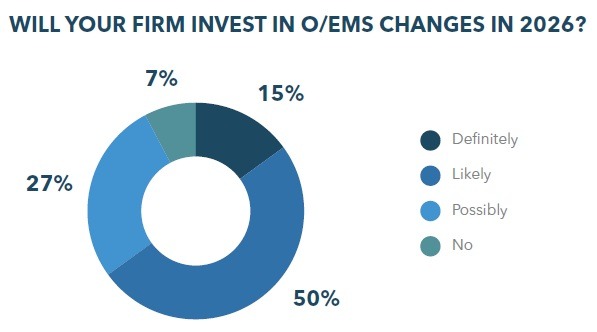
A significant majority of sell-side firms plan to invest in order and execution management systems (O/EMSs) in 2026. According to data collected exclusively for this report by Acuiti, 65% of firms are either definitely or likely to invest in O/EMS changes in 2026. Just 7% of firms are not planning any investment.
Many sell-side firms still operate multiple O/EMSs across different lines of business. That fragmentation increases operational overhead and creates unnecessary integration challenges.
We are seeing growing demand for a consolidated O/EMS model that combines order management and execution management into a single, tightly integrated workflow. Sell-side firms are not just looking to consolidate order and execution management but also to break down the silos across regions, asset classes and trading desks.
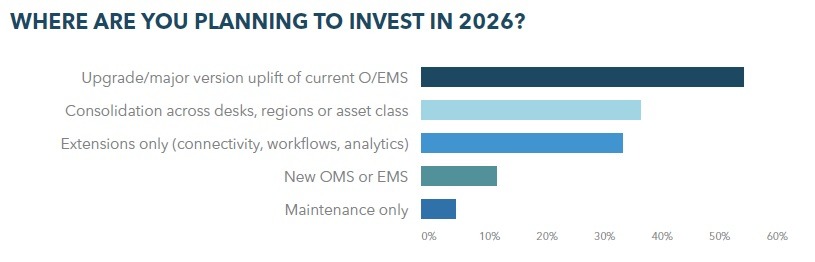
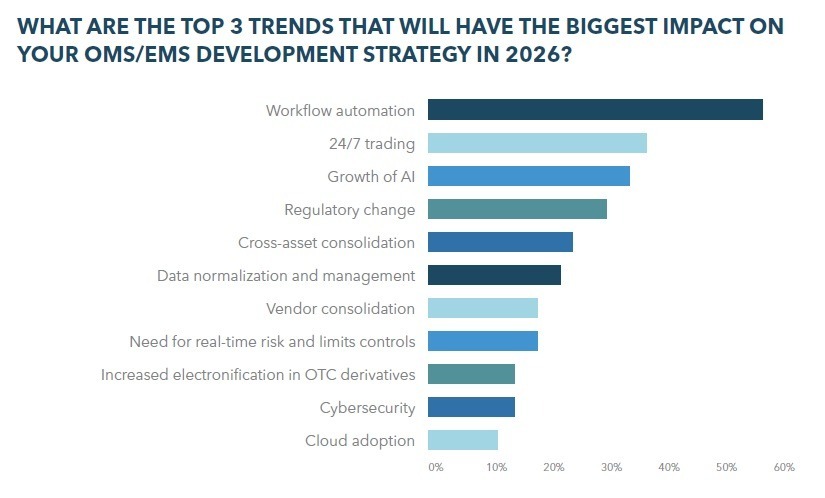
The data supports this shift. Among firms planning O/EMS investment in 2026, 38% cite consolidation of systems across desks, regions or asset classes. Cross-asset consolidation also ranks among the top three strategic priorities for a quarter of firms surveyed.
The benefits of consolidation are clear. By streamlining systems, firms can lower technology overheads and execute through one order flow with a single data source.
The TT platform has been built from the ground up to be asset-class agnostic. While it originated in futures, the platform architecture was always designed to expand. Spot FX, NDFs, forwards and swaps launched last year. In fixed income we’re extending deeper into credit this year. The result is a truly multi-asset environment rather than a collection of stitched-together products.
At the same time, TT remains an open platform with modular services. Clients can adopt the full O/EMS stack or integrate our OMS with an external EMS, or vice versa. Firms can deploy what they need, integrate where required and scale as their business evolves.
AI as an Enhancement, Not a Replacement
AI is now central to technology discussions and the third most significant factor in the sell-side’s development strategy for 2026, according to our findings. The key question is how to apply it responsibly and practically. No firm is looking to switch on a machine and walk away from trading decisions. Instead, AI’s role is to enhance trader judgment.
We already enable traders to select multiple orders and identify potential spreads or multi-leg strategies. The next step is layering AI onto that capability. Use cases include ranking combinations based on current market liquidity, evaluating bid-ask spreads or proposing strategies based on execution-quality metrics.
Throughout, the trader remains in control. AI surfaces insight; the trader makes the decision.
Client analytics present another opportunity. By analyzing historical order flow, AI can build client profiles and identify deviations from typical patterns. If a normally active client is undertrading during a volatile market session, the system can alert the sales desk.
This makes sell-side trading desks more scalable. A trader who previously monitored five clients manually can now monitor forty, with AI highlighting the relevant signals.
AI is not just changing the product; it is transforming how it is built.
Development teams at TT and across the market are already seeing measurable acceleration in build timelines. Roadmaps that traditionally slipped are now running ahead of schedule. The next step is using AI for code reviews and automated testing to match the speed of development output.
Expanding Across the Trade Life Cycle
The research underscores our strategic focus: clients want technology partners that help automate workflows and increase front-office efficiency. Central to this is delivering sophisticated trading capabilities and consolidated tools within a single infrastructure spanning the entire trade life cycle.
Our product and corporate strategies reflect this demand. In December, we announced the acquisition of OpenGamma, which significantly strengthens our offering in portfolio optimization and margin efficiency analytics. Following integration, clients will be able to execute OpenGamma’s recommendations directly through the TT platform.
This complements our partnership with KRM22, which supports advanced pre-trade portfolio risk calculations, including evolving margin frameworks such as CME SPAN 2, ICE IRM2, Eurex Prisma and other exchange models.
Rather than rebuilding specialized tools internally, our strategy is to integrate best-in-class partner solutions into our core platform. With backing from Thoma Bravo, we continue to evaluate opportunities to expand our capabilities, particularly in equities and additional post-trade services.
As clients continue to invest in efficiency, consolidation and automation, we are positioned to help them build a front-office that meets the demands and complexities of capital markets today.
Contact your TT representative to discuss how TT can support your front-office investment strategy in 2026.