Finding the Limits of Automation in Multi-Asset Trading
The rise of buy-side multi-asset trading requires firms to streamline data processing, execution workflows and risk management across different markets. Automation can help make operations more scalable, but success in multi-asset trading depends on understanding which processes can be standardized and where specific market context is essential for trading performance.
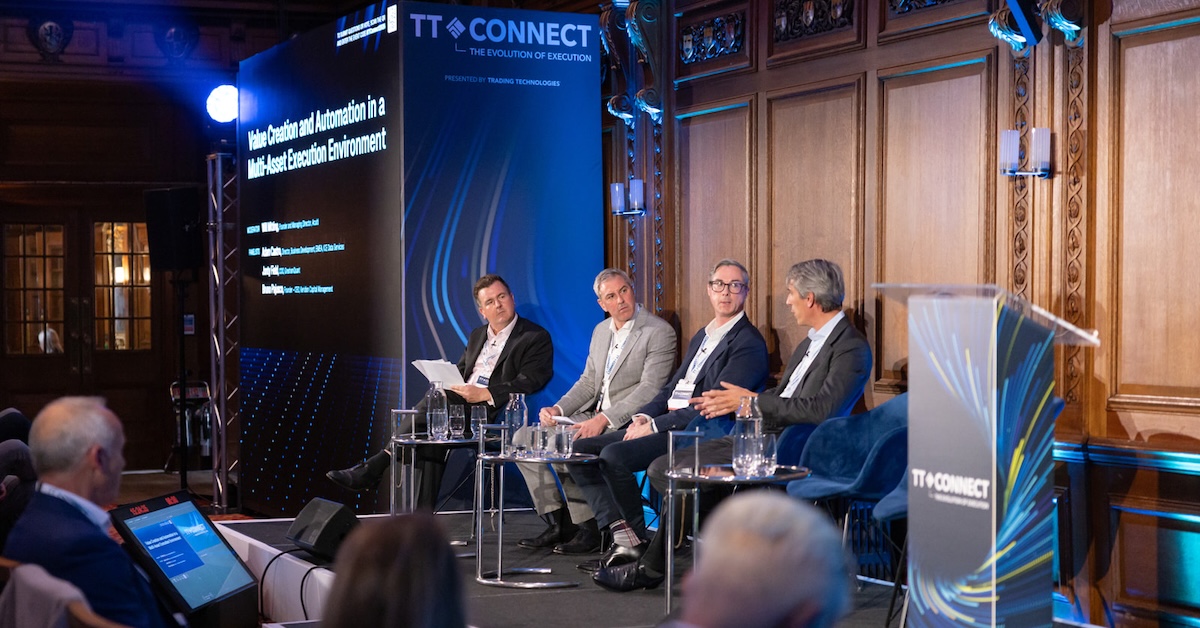
At September’s TT Connect event in London, a buy-side-led panel discussed the move to multi-asset trading environments and the role of automation. Here are my key takeaways from the discussion.
- Workflows can be standardized but specialist expertise remains essential
Buy-side trading desks today typically handle a range of instruments and asset classes with different workflows, context and liquidity profiles. Contract expiries, roll schedules, matching rules and liquidity profiles can vary considerably between asset classes and venues. At the same time, the drivers of volatility and pricing vary significantly across asset classes.
Most buy-side firms don’t have the budget to hire specialists for every instrument they trade. Instead, they must build trading workflows that optimize execution and standardize workflows, but that also accommodate variations across asset classes.
This requires getting the right balance between standardization and specialization, Jonty Field, COO of GreshamQuant, argued on the panel.
“You should have automation and standardization where it makes sense, but you need to build systems that integrate with specialists. Those specialists could be in-house, but they could also be from the vendor or broker that you work with,” he said.
Bruno Pajusco, CEO of Keridion Capital Management, which runs systematic futures strategies across more than 200 contracts, said that portfolio construction should be the focus. Keridion starts with the signals, then builds its portfolio around risk profiles rather than the asset class being traded.
“I don’t see specialism as the enemy of generalism. We pay a lot of attention to how portfolios are constructed. We try to build the best portfolio given where the markets are at that particular moment. Our primary emphasis is on optimizing the portfolio as a whole, rather than treating the underlying asset class as an individual parameter we explicitly optimize for,” he said.
- More data does not necessarily create more value
Quantitative multi-asset strategies require firms to consume more data, but just adding extra datasets doesn’t always result in better performance. Overlapping subscriptions or duplicated processing can add cost without giving trading models anything new.
Piecing together cross-asset data is important. Moves in credit, currencies or rates can provide signals for stocks and commodities.
Alternative data adds another layer of complexity. Often these will come from a wide range of sources well beyond conventional market data, such as satellite feeds of mines and factories to ascertain volumes. This data needs to be sourced, parsed and standardized to feed into systematic strategies.
When firms expand into new markets, the priority should be to identify which inputs the strategy needs, how to source them and to ascertain whether and where they add information that existing sources do not provide.
- AI needs a controlled route into production
Machine learning has long played a part in quantitative trading models. Generative AI extends the potential for automation into coding and operational tasks that were previously completed manually. AI, however, needs controls around its deployment.
Firms that deploy AI must ensure they understand how different datasets have been compiled before a machine acts on them.
If different datasets are merged together, there need to be common syntaxes. At the same time, the data needs to be understood and defendable. Ultimately, for the foreseeable future, AI is going to support trading decisions but a human will need to make the final decisions.
The same discipline applies to AI-generated code. Before code reaches a live trading environment, firms need defined testing, validation and approval procedures to ensure that it is resilient and can be deployed safely. Human oversight remains central to the release of AI-supported code and workflows.
- Prediction markets add another data source but need the same level of scrutiny
Prediction markets can provide additional inputs into multi-asset strategies, particularly where event contracts reference financial and commodity exposures. Many hedge funds already integrate prediction market data into their models.
However, the quality of those signals can vary. Signals driven mainly by speculative retail activity could provide less reliable information than those from markets with substantial institutional participation.
The challenge is therefore the same as with other alternative datasets: to understand the reliability of each signal and its relevance to the trading strategy. Only then should it be integrated into execution workflows.
Principles remain the same across asset classes
A consistent message throughout the discussion was that automation and standardization are key to the efficient expansion of trading strategies across new asset classes and instruments. However, flexibility needs to be embedded into processes, and traders need a deep understanding of both the nuances of each asset class and the data sources that inform their strategies.
TT’s multi-asset execution management system provides one platform to execute, manage and automate trading activity across futures, options, fixed income, FX and cryptocurrencies – with prediction markets and equities being integrated in the near future.
To learn more, contact us by completing our inquiry form.