TT® Learning

Maximize your use of the TT platform with comprehensive yet easy-to-follow learning pathways.

Release Notes

Explore key releases enhancing trade execution and management.
Settings- Sounds for Algo submitted/canceled orders 
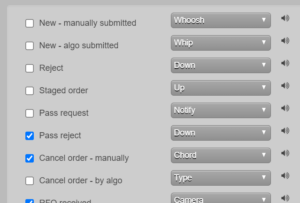
  • Currently, the sounds for “New” and “Cancel” orders play for both manual orders and orders by automated tools. We have now separated the order actions between manual and algo to allow you to be notified when one or the other occurs. To implement this, the current two sound settings have been renamed to reference manual actions, and we have added two new sound settings for algo actions. 
Settings-  Increase number of custom action buttons
  • You can now configure up to fifty (50) custom action buttons on the Order Ticket and MD Trader. Previously the limit was twenty (20) buttons per widget.
OMS  Care order passing
  • We have extended our current OMS order passing ability to now include the ability to pass staged orders.


Upcoming

Order Book display Rejected orders for the current session
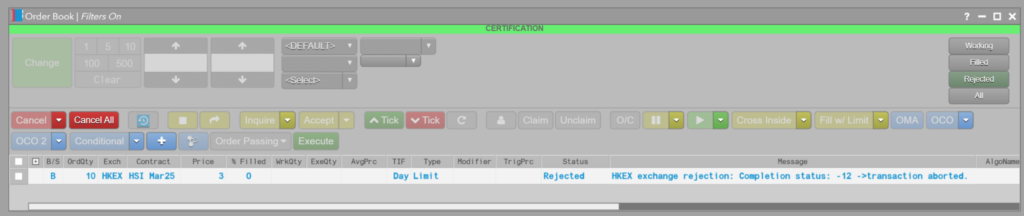
  • The Order Book and Orders and Fills widget (OFW) now display rejected orders for the current session. A new “Message” column can optionally be exposed that displays the same reject message text displayed in the Audit Trail. The Message column supports filtering/searching on the message text string. A new quick filter button named “Rejected” displays in the top upper right portion of the Order Book, that when clicked applies a filter to only show rejected orders. Also as part of this work, in the Order Book Settings you can also customize the row color for rejected orders.

Display Settlement Date for NDFs and Spot FX 
  • We now display Settlement Date for NDFs and Spot FX in the appropriate grid widgets, e.g., OB, OFW, Fills, Audit Trail, etc.


The following is a guest post by Christopher Rodriguez, chief marketing and relationship management officer of Eris Exchange, and Geoffrey Sharp, Eris’ managing director and head of sales. Eris is a U.S. futures exchange that offers listed interest rate swap futures. Trading Technologies offers connectivity to Eris through both the TT® and X_TRADER® platforms.

Some traders were more prepared than others for the results of the U.S. presidential election in November. Higher implied volatility, changes in risk premium and increases in interest rates resulted from Donald Trump’s surprise victory. Equity markets plunged then rallied. All told, the month of November was remarkable for traders.

Heading into Thanksgiving, 10-year Treasury Note Yields reached highs not seen since the middle of 2015. The bond sell-off tapered toward month-end, but the forwards predicted a more aggressively rising rate environment. Continue Reading →


The following is a guest post authored by Steve H. Hanke (Twitter: @steve_hanke). He is a professor of applied economics and co-director of the Institute for Applied Economics, Global Health, and the Study of Business Enterprise at The Johns Hopkins University in Baltimore, a TT CampusConnect™ partner school. He is a senior fellow and director of the Troubled Currencies Project at the Cato Institute.

This post was originally published on the Cato Institute blog. At the time of publication in September, Steve was predicting crude oil futures would be priced around $45-46/bbl in mid-November. The market appears to be confirming his projections, with CLZ6 closing yesterday at $48.03.

Continue Reading →

Here we are again. Just when we all thought we had it figured out, the election whizzed on the electric fence. Now it is time for the long awaited December FOMC meeting. I’ve written before about positive expected value and a process focused trading discipline. Focusing on the process, i.e., the positive expected value, rather than the outcome enables one to take on asymmetric payoffs with positive expectation even when the payoff is unlikely. Right now, we are heading into this meeting, and the market is pricing the likelihood of a tightening at near certainty. Count me in on expecting a rate hike, but if you have learned anything this year, it should be to expect the unexpected.

Continue Reading →

Brett N. Steenbarger, Ph.D. is Clinical Associate Professor of Psychiatry and Behavioral Sciences at SUNY Upstate Medical University in Syracuse, NY, where he specializes in the teaching and practice of brief approaches to counseling and psychotherapy. Brett’s main work is with traders and portfolio managers in the financial markets at hedge funds, proprietary trading firms and other money management organizations. Brett is the author of the TraderFeed blog and several books on trading psychology, including “The Psychology of Trading” (2003), “Enhancing Trader Performance” (2006), “The Daily Trading Coach” (2009) and “Trading Psychology 2.0” (2015). He is currently working on a third edition of “The Art and Science of Brief Psychotherapies,” an academic text and training guide for mental health professionals.

Given that we are in the midst of a chaos-themed campaign showing traders how to get through the most chaotic market periods using the TT® platform, we wanted to get Brett’s take on the industry and how analytics and psychology drive decisions in times of chaos. Read on for his perspective.

Continue Reading →

The following is a guest post authored by Geoffrey Parker. He is a professor of engineering at Dartmouth College and a visiting scholar and research fellow at the MIT Initiative for the Digital Economy. Before joining academia, he held positions in engineering and finance at General Electric. He has made significant contributions to the economics of network effects as co-developer of the theory of two-sided networks. He received his BS from Princeton and his MS and PhD from MIT. You can follow Geoff on Twitter at @g2parker.

Given the dramatic change now underway in financial markets and exchanges, it’s tempting to believe that the industry is in uncharted territory. And, as we’ll see below, there is some truth to this view. However, it’s worth remembering that the industry went through a similar phase of change when exchanges such as the CME became electronic instead of physical markets. Floor traders gave way to traders sitting at computer terminals and, increasingly, to algorithmic trading machines. Electronic completion offered a number of immediate advantages that included better price discovery, improved access to markets and a better ability to create customized products that better fit needs. For example, firms that wished to smooth the value of assets such as power plants or pipelines against commodity price volatility were able to tailor their hedging strategies to their exact needs.

Continue Reading →

Cookie Settings
Trading Technologies

We use cookies to analyze the usage of this site, personalize your digital experience and serve you tailored advertising content. You may accept or opt-out of the use of certain cookies. Essential cookies are always active because they are required to provide the basic functionalities of the site. By clicking “[Accept All],” you grant us permission to use and disclose information about you and your interactions with this site to our third-party analytics and advertising partners. You may withdraw your permission at any time by clicking “[Cookie Preferences]” at the bottom of our website and selecting “[Reject All].” If you withdraw your permission, your digital experience and advertising content may not be personalized or targeted to you directly. You may also reject some types of cookies, which may impact your experience as certain features on our site may be unavailable. For more information about our use of cookies or our privacy practices, please review our Cookie Policy and Privacy Policy.

Strictly Necessary Cookies

These cookies are required for our website's basic features and technical functions. These cookies save information required for the website to function properly and cannot be turned off. These include cookies used for website security, website technical statistics, and site features.

Performance Cookies

These cookies enable us and our third-party analytic partners to analyze site traffic, user navigation and user engagement. These include cookies that analyze number of unique website visitors and their interactions with our website.

Targeting Cookies

These cookies enable us and our third-party advertising partners to build profiles of website visitors, show them targeted advertisements tailored to their interests, or track the effectiveness of advertising campaigns.